
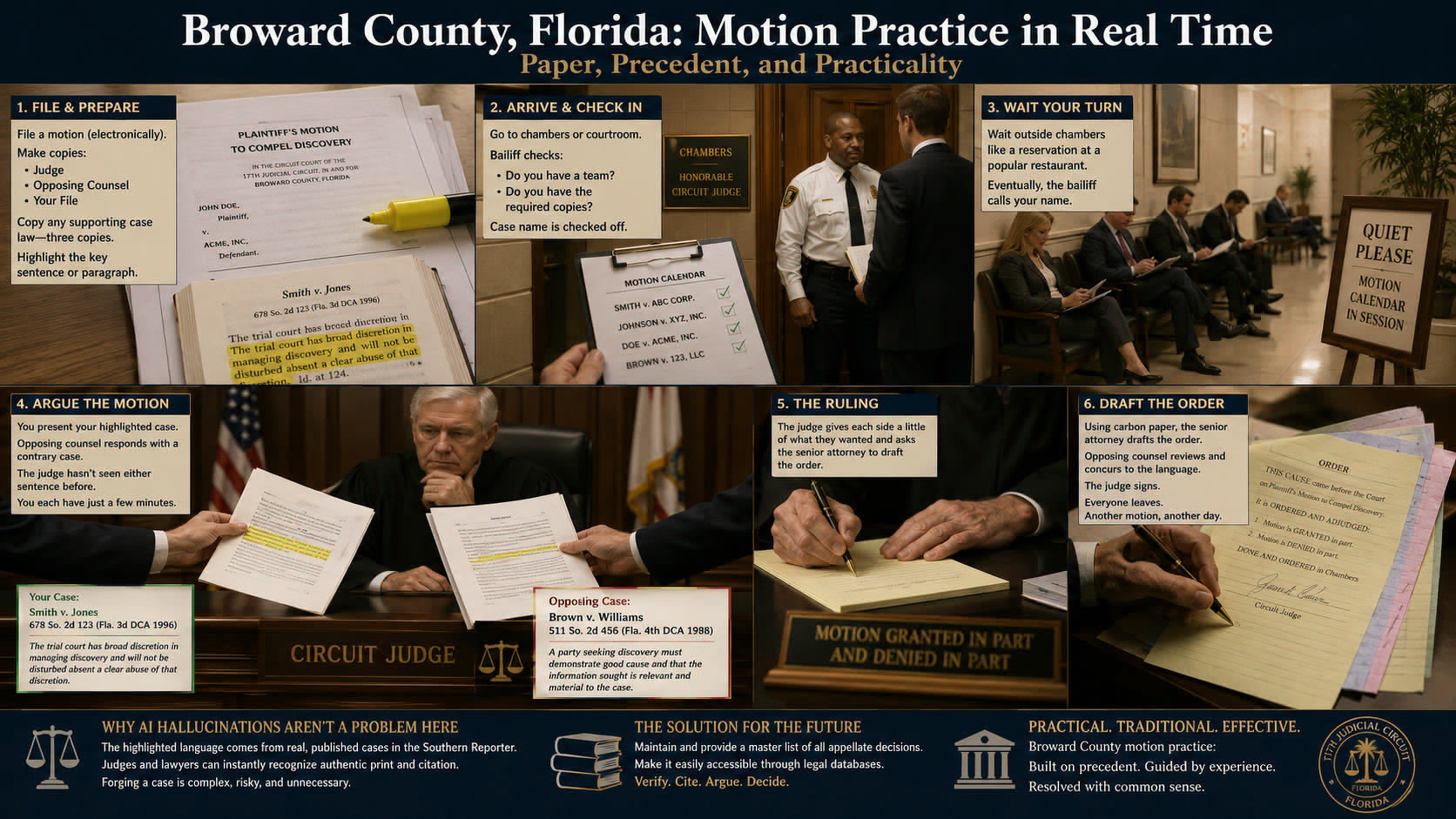
I don’t think there’s much of a chance that AI hallucinations will ever be a problem in Broward County, Florida’s circuit civil motion practice. Here’s how the system works: a party files a motion. This used to be done on paper, but I’ll assume that there’s a way to do this electronically. You make several copies of the motion: one for the judge, one for your opposing party, one for yourself. If you are relying on a case, you copy the case. Again, three copies. You then take a yellow highlighter and highlight the key sentence or paragraph from the case. Sharp practice calls for not giving a copy of this case to your counterpart in advance. You go to chambers or a courtroom depending on the judge’s preference. If it’s chambers, a bailiff outside will ask if you have a team. He’ll also check to make sure you have the required copies. If you are compliant, the case name will be checked off. You have to schedule the motion separately since filing somehow is not enough. You wait outside, as you would if you were waiting on a table at an exclusive and highly-popular restaurant. Eventually, the bailiff calls your name and you file in. You’ll slide a judge’s copy of the case with the highlighted text in the direction of the judge. A young lawyer will ask for permission or hand the document directly; the older lawyer has contributed money to the judge’s re-election campaign and such niceties may in his case be dispensed with. If you opponent is good, he slides in your direction a case you haven’t seen before, with a sentence that contradicts yours appropriately highlghted. The judge hasn’t seen either sentence before and both are plausible. He looks and sees that your sentence was written by the 3rd DCA; your opponent’s is from the 4th but a quarter-century ago. You each have but a few minutes to argue; motion practice is mostly about discovery disputes and these storms are easily contained. The judge gives each side a little bit of what they wanted and asks the older lawyer to draft the order. For this eventuality, you brought ever more difficult to find carbon paper. You don’t want to draft an eloquent order back at your office, you need opposing counsel’s concurrence so that the judge is assured the draft motion accurately reflects his decision.
How does AI play into this? The papers you’ve highlighted are photocopies of actual cases you’ve pulled from the law library. The judge can instantly see that the highlighted sentence you’ve copied is from one of the volumes of the Southern Reporter. No one would attempt to forge a case. In the old days it would have been difficult enough, today it is still a challenge. Do you know what font is used by West’s Reprter System? If you guessed “Times New Roman” you’d be wrong. Do you know how to duplicate that system’s image of a key? There’s no key combination to bring it up. Do you know how to span footnotes across columnar text? I didn’t think so. A lawyer planning on counterfeiting a case to use at motion calendar is faced with a complex task. Could you do it? Yes. After all, people counterfeit $100 bills. Would you do it? No.
AI will get there because there is a simple answer to hallucinated cases. There is a defined universe of cases; on the federal side these begin with 1 Dallas (1 U.S.). If you had access to Westlaw/Lexis, maybe Google Scholar, certainly the DoJ’s Juris and maybe the Air Force’s FLITE, all you would need to do is check the master list of cases against the cases in a Table of Authorities. This is trivial; you do it perhaps dozens of times a day every time you access a search engine. Let’s not despair; let’s require the legal database minders to make such a list accessible.