
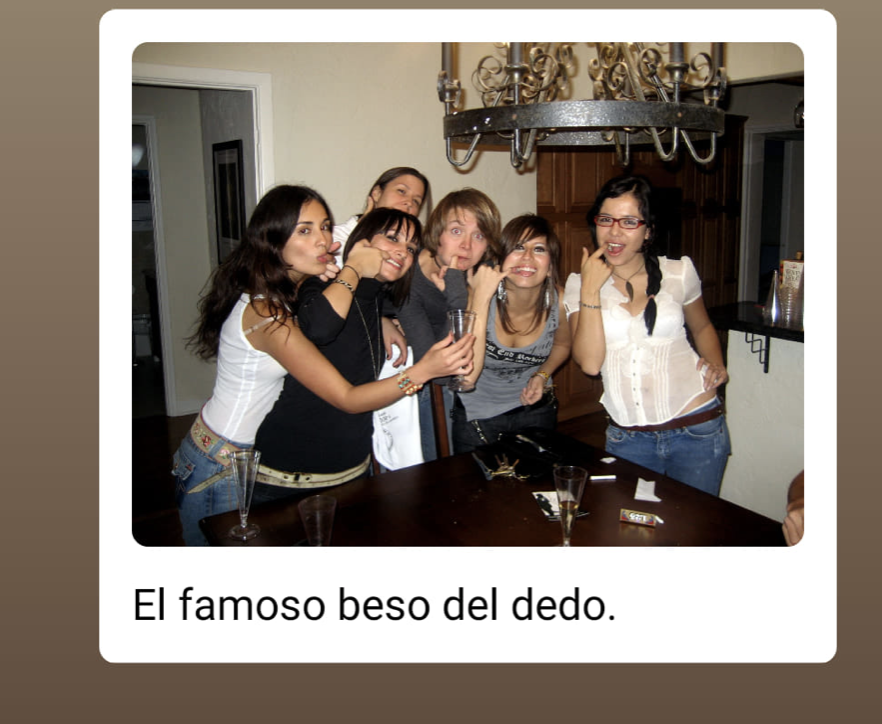
(Beso del dedo)
Sundays I was in prison, planning with clients for hearings that week. One day I realized that I was spending more time in prison than many of them. My friends went out together, visited family: I went to jail. Relaxation was always hard to schedule, it is difficult to tell the mind to relax when the court hearing is tomorrow and what if the prosecution says this, how will I respond?
It is playing and replaying past trials in your head, remembering your mistakes in order to avoid repeating them, but each mistake stands as a witness against you, testifies about the error in a loud voice reminding you of that moment when you thought “shit” whether you said it or not. Afterwards you felt bad. Feeling bad leads to depression. Relaxation and depression are poor companions.
A good while ago, I found myself sitting at Van Dyke’s on Lincoln Road, an open air café; it was about seven pm or so, the sun was setting, rain came and went sporadically. I was sitting at the bar having a glass of champagne and talking to Kristen, the bartender.
It was another night in which I pretended to put together a social life for myself; to see if I might find an answer to the question posed by Cortazar, ¿encontraría a la Maga?
I had a part-time job as a translator for a BigLaw outfit, famous for defending tobacco companies. The case I was working on involved decorative ferns damaged by a once-popular anti-fungal. I was part of an international team including Venezuelans, Colombians, one Peruvian and a guy from Spain who slept at the office to avoid a long commute.
Kristen, the Van Dyke bartender, was from Ohio and a fully-qualified attorney. She gave up her legal career to be a bartender in Miami Beach. Her boyfriend was an unemployed jazz musician who scrapped or stole street metal between gigs. “My father wanted me to get a law degree,” she told me, “so to make him happy, I did. Now my life is my own.” She urged her boyfriend to find regular employment but somehow a “white man” was an impediment.
Kristen’s law license was her secret but one time she let it slip while I was sitting on my favorite chair in the corner, watching the people walk by, sipping my champagne, with generous pours and quick refills courtesy of the former lawyer.
One of her boyfriend’s friends was at the bar with a woman who asked a legal question. Kristen answered as if drilled without realizing that only a lawyer would know the answer. It is a habit of lawyers to do so. Our lives are quiz shows because we have studied long and hard to imprint this information that sometimes just comes bursting out.
Kristen got out of it by telling the two of them that she had heard me answer this question once and then pointed to me in the corner. The two of them came over and we had a brief discussion about a problem that wasn’t really a problem but if it were your problem, would seem overwhelming.
The friend’s boyfriend asked me what kind of law I practiced and I told him criminal law. He asked me what kind and I told him, “Federal criminal. Mostly narcotics. Drug cases."
He asked me if I knew about Willy and Sal. I told him that I had, but I never had any cases involving their organization that I knew of. But my paralegal had dated one of Willy’s lieutenants. Her story was involved; a story of true love interfered with by the federal criminal justice system.
Prudent drug smugglers do not suffer the presence of innocent bystanders but family and girlfriends are in a twilight area. They know but they cannot know, to know makes them conspirators, so they pretend not to know what they know. Eventually it all comes out anyway.
In my paralegal’s case, one of the key pieces of information that was kept away from her was the fact that her boyfriend was married. He claimed that he was just about to divorce his wife, but his wife was related to Willy, so he couldn’t. A divorce would bring in divorce lawyers, financial affidavits that were fiction; it would create problems and in a major drug trafficking organization, the last thing you want to have are problems. “Did she know Willy?” the boyfriend asked.
“Of course,” I told him. But after he was arrested seeing any of them was difficult. They were in lockdown, in solitary. Attorney visits and that was it. Frank Rubino was one of the lawyers and I had had enough of Frank during the Noriega case. Still, I knew that Frank couldn’t do much if I designated her as my paralegal so she could get in to see Willy.
Even though my paralegal no longer dated Willy’s associate, she was still in touch with Willy’s family. If Rubino complained that I was trying to steal his client, Willy would set him straight. So I wrote a letter for my new paralegal. It wasn’t a lie, just an exaggeration. She had taken paralegal courses at Miami-Dade and Judge Larry King was one of her professors. Over the years she had done work for me. The US Marshals granted her access to the show trial of Willy and Sal.
I happened to be in court on one of the days of Willy’s trial. When I saw her I was surprised.
“You know that paralegals don’t dress like that,” I said.
“And you know that I always dress for court.”
I couldn’t disagree with her.
Kristen came by to ask us if we wanted another round. The boyfriend whispered something to her and Kristen came by with a bottle of champagne. “Let’s celebrate,” he said, “to the past. We got out unscathed.”
“You?” I asked. I didn’t finish the sentence.
“I got lucky,” he said, “really lucky. I got picked up with five keys and an AK-47.”
“Really lucky,” I said, “you had a real problem. Armed drug trafficking with a machine gun. Ten years minimum.”
“It wasn’t even my gun,” he said.
“It never is,” I agreed.
“No,” he said, “not like that. I did borrow it. I was on my way to return it but I got stopped. Fortunately, the stop was ruled bad and the evidence suppressed. I was in jail for four months, happy to get out.”
In Miami, the dark side was anywhere and everywhere.
“It could have been a lot worse,” I told him. Armed narcotics trafficking. Like twenty years worse.”
The champagne was sweet. Extra dry. They don’t drink much of it in the U.S., but it’s a European favorite and so available on South Beach. Europe was where the cocaine was going anyway. Maybe that’s why they let him go.
After they left, I noticed a woman sitting alone at the bar; I told Kristen that she looked very unhappy.
She had just sat down at the bar; she was wearing a flouncy skirt that matched a Hermès Kelly and carried her shopping in a Victoria’s Secret tote. Very feminine, but she was drinking beer out of a bottle. She wore a man’s Patek-Philippe chronograph which at 39 mm was too big for her wrist. Her name was Claudia; offered with reluctance. She asked Kristen if she could smoke and Kristen directed her to the bar’s Lincoln Road side, the side where I was sitting.
Claudia approached me and I said the chair next to me was empty. She sat down next to me, and I thought; well, might as well switch from Eeyore-like glum to positivity.
So.
She was enchanting.
I asked her where she was from, if she was from Miami or a tourist. She said that she was from Guadalajara, Mexico. She didn’t have a Mexican accent though. I made a few more comments; the conversation ambled along. There was something about her, though, that was extremely attractive. Extremely. Not so attractive in the sense of, here’s a blonde bombshell or a woman who has all of the attributes that one is supposed to lust after: big breasts, blowjob lips, an ample backside. No.
With Claudia it was something very different. So different I’m not sure that I have been exposed to that different many times in my life, if at all. But at least this time I think I recognized it. And I thought, this is someone with whom I could commit a great folly.
But first, I asked her if she was single or divorced. She told me that she was widowed. I said that was impossible, she was way too young to be a widow.
“My husband died a few months ago,” she answered.
He had died of a sudden illness. He had died in her arms. She was distraught. They had been together for ten years. She had come to Miami to stay with her mother.
There had been two immediate consequences to her husband’s death. An avalanche of litigation. And her husband’s friends had all started hitting on her. This unnerved her.
We continued to talk. As it turned out, she wasn’t really Mexican, though she lived in Mexico. She was from France; a small town near Lyon. She had met her husband, a Mexican national, at university there. He was studying to be an engineer. They had a splendid, quick romance, a wonderful life together. They moved back to Mexico.
Then he had a heart attack. That life was over.
I told her that it would be months before she could have a normal relationship and that anyone who had suffered a break-up could only barely imagine what she was going through.
There was something in her eyes. She asked me about myself, I told her that I was a lawyer. She said, “in life it’s important to have a good lawyer, a good accountant and a good lover.” This seemed sage advice.
She asked what I was drinking and I told her champagne and then bought her a glass. She told me about her life in Mexico; she had written and published poetry. She liked Ted Berrigan and asked me if I knew his poem Tambourine Life. Her own poetry she wrote in French or Spanish. “They’re more similar than you think,” she said.
She wasn’t sure where she would live. She left Mexico City and came to Miami to grieve and to forget. She liked Miami, she had come many times with her husband. But there were resonances of him everywhere. On her way to Victoria’s Secret she had passed by Burdine’s. That’s where she had bought him shirts whenever they came to Miami. Passing a pay phone on Ocean Drive she had used to call him back after he beeped her brought back thoughts of him.
She told me she had a loft on Euclid Street and that I should come and see it some day.
She said she had to meet her mother and took a telephone call. I told her that she wasn’t going anywhere and she seemed surprised until I pointed out that the rain was now heavily coming down. So we continued chatting at the bar; I told her more about myself.
We only spoke in Spanish; she seemed to understand English but I didn’t try to test her. I told her about Arabia, in general terms. I told her about Dr. Arnaldo Parra, the Panamanian psychiatrist who treated the Shah of Iran and his belief that time should be divided between Latin America, Europe and Manhattan. It was an extremely civilized way to live, but would require a great deal of money.
As time passed Lincoln Road’s restaurants filled with customers, including Van Dyke’s. I asked Kristen if we could order food at the bar, so we did.
Claudia told me about her life with her husband; their house, their automobiles, their possessions. “We lived well,” she said, “but those things don’t matter. We truly loved each other.”
I felt sorry for her. She continued. “I would do anything for my husband. Anything.” She emphasized the last word. “I wore uniforms. He liked the French maid one, and because I am French, it was easy to play that role.
We played games a lot. Acting. I brought women home so we could have threesomes. I knew his friends, I know how Mexican men are. I didn’t want him to go looking outside the home for anything. Anything. I wanted him to think that cheating with me was better than cheating alone.”
“It’s not cheating if you’re both in it together,” I pointed out.
“True,” she said. “But it’s all over.”
She was crying.
“What are you going to do?” I asked her. We hadn’t spoken too much about the future.
“I guess go back to France. But I don’t know. I’ve made my life in Mexico.”
I asked her if she would like to continue the conversation some time. We exchanged numbers.
I wanted to see her again.
I sat there after she left thinking how a person’s life might be changed utterly just by having met a stranger at a bar. But I had a cynical feeling that this would lead to nothing. I had met people at bars before and never had seen them again.
Eventually I ordered these thoughts in some fashion by variously dismissing one or the other, but ultimately I felt that something important had happened.
I still had to make an appearance at a birthday party. When I got there, I discreetly told a friend about meeting Claudia and he told me to be careful; that it was likely the woman was a murderess who had poisoned her husband for his money. I had not previously considered this possibility.
That would fit Miami as well.
I called Claudia two days later. It was about three in the afternoon, she told me that she was in a cabaña at Nikki Beach and that I should join her there.
There was no way I could go; I was working. Going to the Beach in the afternoon was out of the question. So we agreed to meet instead on Thursday night.
Thursday night, unfortunately, came and went. She didn’t show up. I left her an email calling her an ‘embarcadora,’ (in Cuban slang, someone who stands someone else up) and left it at that. She called back Friday night around 9:00 pm, but I didn’t get the message. I called her Saturday afternoon and we agreed to meet on Sunday. She claimed that she had gotten lost and had left me a message. As to getting lost, that’s possible, but there was no message.
On Sunday we met at Touch on Lincoln Road. It was too early, the place was just opening up, so we went to Van Dyke’s. Van Dyke’s was crowded, it was very difficult t get a seat. There were a group of somewhat butchy women, all drinking beer from bottles. Claudia listened to their conversation for a while and said, “do you notice how vacuous their conversation seems? And yet they’re happy. When women talk it usually sounds just like meaningless chatter. To find the real meaning you really have to dig.”
I told her that the only thing I had picked up on was the fact that the women were a little mannish. She said that women were vastly more complicated than men, and almost beyond understanding.
We then went back to Touch, but decided that we weren’t hungry so we just ordered mojitos at the bar. She started off by telling me that women liked to seduce her. This seemed to flow from our earlier conversation at Van Dyke’s.
She asked me if she could tell me things without me judging her, so I said, sure, go ahead. She told me that she liked to let women seduce her and then dump them in the morning, not have anything else to do with them.
Though she would often bring these women home for a threesome with her husband, ‘a gift I gave to him,’ she said. She said that she had told her husband, what’s good for the goose, etc. and that she wanted to do two guys at once; but that while her husband had approved intellectually he could never bring himself to do it; and had once gotten violent with a man she had approached in a bar.
She said that she had tried to be everything for her husband so that he would never be tempted to look outside their home or their marriage. She said she was his whore, his lover, his best friend. She said that she wore costumes, she dressed as a nurse, as a policewoman, he said she did everything. Everything. She again asked me if I would judge her and told her no. She said that after his death, she had felt very horny and so had called a male prostitute, but she couldn’t bring herself to go through with it. She said the guy called her the next day and offered his services for free.
I asked her then, ‘what was the most audacious thing you ever did?’ She thought for a minute and replied, “entregarme por diez años a mi marido, cuerpo y alma.” This was quite an unexpected answer, and enormously eloquent, given what we were talking about.
She told me she had modeled for ten years, she told me what schools she had gone to in Mexico. She liked to decorate, she told me that she thought she had good taste. There was one dissonant item—she said that she was looking to open a pop-up stand with her mother on Lincoln Road selling Mexican food, or perhaps handicrafts on Hispaniola Way—she wasn’t sure, she wanted to have something to do.
She told me that she still spoke to her husband at night, before she went to sleep. That his portrait on the wall in their house in Guadalajara had fallen from the wall without explanation.
We talked a lot about Mexico, the capital, I told her how I used to be able to fly for free when I worked for Mexicana Airlines as a young man.
She told me that she didn’t want to have any serious relationships. But still. After she said this, we were sitting next to each other, very close, she told me she needed to go to the Ladies Room. I thought, ‘she’s waiting for you to kiss her, you idiot.’
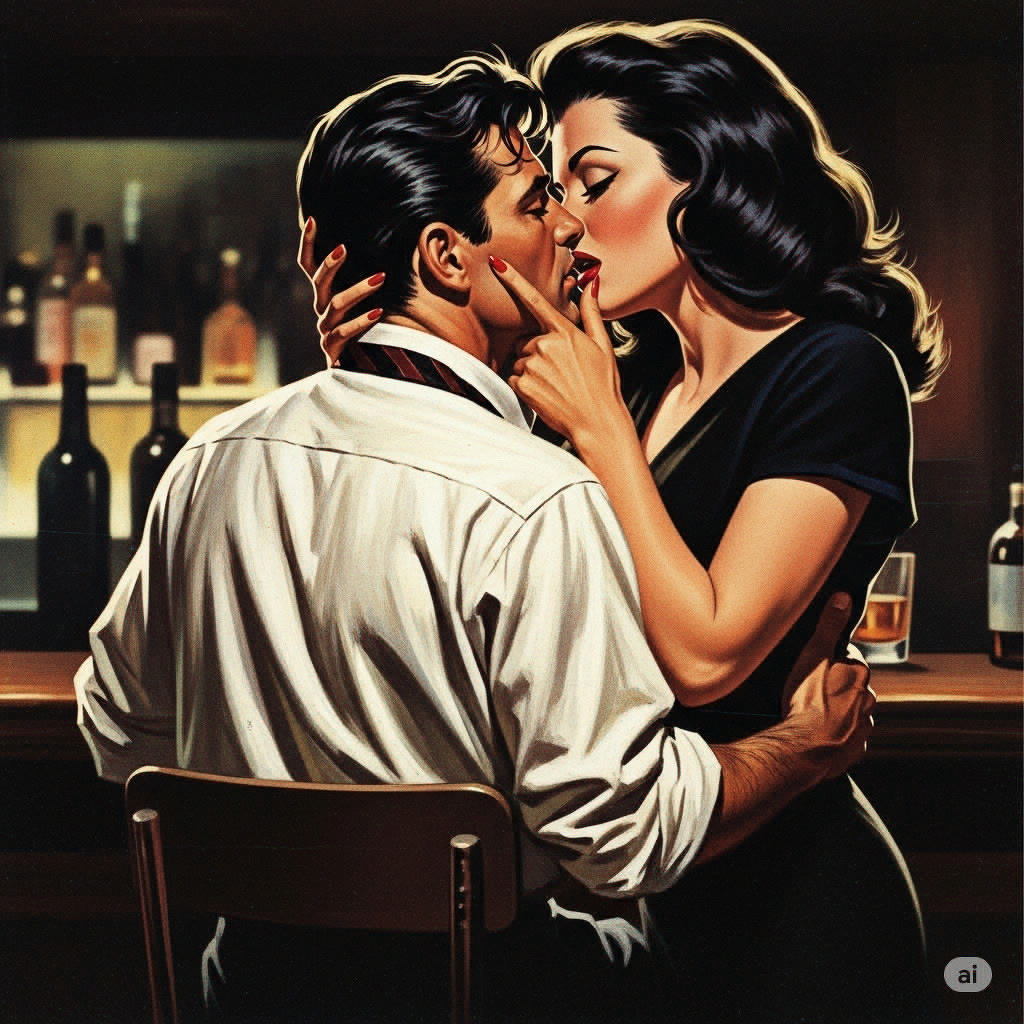
I told her no, and she said, ‘why not?’ and I said, “because I don’t want to wear your shade,’ and then I kissed her. She stood up and said, ‘no, if you’re going to kiss me it has to be a real kiss.’ She moved closer to me.
There are kisses and there is melding and this was melding—her index finger found its way to my mouth; the finger kiss was extraordinary. I could only imagine the rest of her skills.
She broke off the kiss and excused herself.
When she returned, she wanted to go dancing; she told me that Nikki Beach had a good scene on Sunday nights, so we left.
We walked onto the street where there were cabs waiting. We got in and headed south. In the car we talked about Mexican politics, los caciques, what it means to have real money. At Nikki Beach we sat down, had two beers Pacífico, of course, no limes.
Nikki Beach is an upscale sand on the floor beach club; bar, restaurant, night club. At that hour, there was no problem getting in. She walked around a bit and we sat down. No one was on the dance floor; it was just too early.
She said that she wanted to go to the VIP room, her brother—brother?—knew someone there, she’d be back in ten minutes. She left her cigarettes and a disposable lighter on our table.
She walked out the door. Fifteen minutes later, she still hadn’t come back. I went to the front door, but she wasn’t there. I came back to where we had been sitting, but we hadn’t passed each other. I walked around to the different drink stations but she wasn’t at any of them. Perhaps she was in the ladies'? But after half an hour, nothing. As the clock ticked towards an hour, I realized she wasn’t coming back.
An hour later she had not returned. So I left. Since then she hasn’t taken my calls. I feel like I had an extraordinary chance (i.e., like Joyce, “an envoy from the mortal courts of youth and beauty”) but somehow I blew it. So close, so very, very close.
I went back to Van Dyke’s; it was still open. Kristen was cleaning up. I told her, “look, I know this is weird, but I want you to do a favor for me. I’m going to take off my shirt and I want you to note if there are any marks or scratches. Anything that would look like I had been in a struggle.” I took off my shirt. The patrons at their tables watched the show.
“Why?” Kristen said.
“I’ve been ditched,” I said. “At least I think I’ve been ditched. I don’t know what happened to her.”
“The girl you were with last week? The two of you were really talking.”
“I don’t know what happened. One minute she’s there, the next minute she’s gone. If something’s happened to her, I don’t want to be accused.”
The next morning I called the number Claudia had given me to make sure she was alright. She didn’t answer. I tried again a few days later; nothing. The final time I called I got a BellSouth recording, Claudia’s number had been disconnected.
The next day in the office I told the story to my BigLaw work colleagues. The women were intrigued and wanted to know more about the kiss. Others thought that I had made the whole thing up. A few days later, one of them told me that she had straddled her husband on the ground, held his mouth open and poked her finger inside. She said that he had gagged.
“That’s not how it’s done,” I said.
In time the story took on a life of its own. On lazy Sunday afternoons I didn’t see Claudia at Van Dyke’s. Kristen’s friend, the one that had bought the bottle of champagne to celebrate his freedom, got in trouble again, and this time it really wasn’t his fault.
He had lent his car to a friend who ran it without oil and blew the engine. A black, 300-series Mercedes. The friend had no money to replace the engine and offered his own Lexus in exchange. It was a fair deal but the paperwork was all wrong. The Lexus was owned by a heroin dealer who took a key and didn’t pay for it. He offered up the Lexus as collateral but reported it stolen the next day.
You don’t steal from a heroin dealer and you certainly don’t steal twice. The heroin dealer gave the Lexus to his girlfriend and somehow Kristen’s friend ended up with it. Mentioning the word “heroin” as the underlying consideration for a car sale simply wouldn’t do. Kristen’s friend was living at the old Holiday Inn near the State courthouse on 12th Street, the very definition of a transient life.
When Barry Hodus died his stepdaughter took over the bond business. I had worked with Barry for years. She was skeptical about writing a bond for a transient, a person living in a hotel, but I convinced her to do so. Kristen’s friend had been living in the hotel for months, which for Miami is a mark of permanence.
It was impossible to explain what had really happened without unraveling a heroin transaction. Cars being traded for heroin is a bit much, even for Miami. A kilo’s worth is a lot of heroin. Corsican traffickers have been known to slit throats over such amounts.
On the morning of the arraignment, the State nolle prossed the case. I never learned why. Kristen’s friend told me I was a magician and a great lawyer.
Only the result matters.
When passing me in the hall, the girls in the office would hook a finger in their cheek and smile.
When the BigLaw Miami fern case was over, we were all laid off. I begged the firm to let me stay on but they wouldn’t hear of it. There would be no more afternoons at Van Dykes. I had to leave Florida. In some ways, even with the nightly mortaring, Iraq was more peaceful. I reached a few contacts and got another job with another company. In Iraq. In the Green Zone.
After Iraq, arrival in Berlin. Late at night, nowhere to exchange money. A cab dropped me off at a business hotel near the Tiergarten. I was reading Banat ar-Riyadh on the airplane in from Beirut. Trapped in the airport without a visa; just as well: Nasrallah’s men might take an interest.
An office that wasn’t an office but shared with others, on the Friedrichstrasse. The office manager with something in her hand. For me, an envelope. How was Iraq? Sent from Schiphol, the airport in Amsterdam. No return address. Addressed to me at our home office in Munich, forwarded from there.
The envelope contained a newspaper clipping. A gang of South American women had been broken up. They spiked drinks of rich men. Ruphynol. Scopolamine. With the right concentration, not much was needed. Spread on the lips, it was tasteless, colorless, odorless. You could dab it on the lips easily. Say, with a finger.
The women told their targets sad stories about being left widows at a young age; their husbands dying from heart attacks or drowning while swimming. To draw the men in, the women claimed to be sexually adventurous. At least one of their victims had not tolerated the drug; they left his body next to a dumpster at an infrequently visited bar in an alley off the Bahnhofstrasse. They kept his watch. The law treated this as murder.
Active now in Switzerland, the gang had previously operated in the United States, especially in Florida. The police had tracked expensive watches turning up in pawn shops in Palm Beach, always pawned by South American women with impeccable passports that always turned out to be forged.
In Geneva, a Saudi diplomat who was connected to the Malaysian 1MDB scandal found himself in a bedroom after meeting a woman in a bar. He was a client, a former client. He thought the woman was Venezuelan. Fluent in Arabic, English and French, he did not recognize the language spoken in the apartment. Could have been Spanish. He had been kidnapped before, but not by a gang of Venezuelan women.
The bedroom door was unlocked, he left and the woman he thought was Venezuelan called his cell which they had not taken away from him and asked him to return to the apartment.
When he filed his report, the Saudi diplomat could not help the Cantonal police identify the woman who had drugged him. His country had many enemies. He was especially worried about Syria but did not tell the police of his concerns. He could not understand why the woman had let him go. His watch was missing as well.
The Swiss police concluded that the kidnapping had something to do with 1MDB, a scandal so complex no one really understood it all. They suspected the involvement of the Syrian mukhabarat and some kind of operation run out of Damascus. I wondered if the unmarked letter to me played a part.
The mukhabarat had a ruthlessly efficient security system in place: if they found that one of their agents had spoken to agents from a foreign country, he was executed. Mere contact was enough and eliminated the possibility that an agent might be turned. I didn’t know who had sent the letter. The Cantonal police had their suspicions.
The woman who was the gang leader was still at large. An Interpol Red Notice had issued. The newspaper article reprinted a blurry photograph from a CCTV camera, but the picture was clear enough.
Claudia.